Tuesday, April 5, 2016

Online Education


Image result for online education
Retrieved from: Online Education
Distance education is becoming more and more popular at the high school level. According to Synonym, "Distance education nowadays means on-line education with various instructional delivery models, synchronous or asynchronous, using Internet or TV." Many times, students opt into obtaining their high school credits via an on-line course offered by the school or the distract. In Ontario, students can receive high school credits by enrolling in classes on-line at Ontario's Designated Provider of Distance Education - Independent Learning Centre. Students can browse through the courses provided and enrol in whatever they wish.
I believe distance education is revolutionary! With distance education students can learn to manage their time. They have the opportunity to hold part-time jobs during the typical school hours and earn the credits they need to graduate high school. All in all, on-line education teaches students responsibility and time management; something that many students seem to struggle with nowadays.

Ryan's Resource- Using Drama in Multi-Content Areas to Assess Students With Social/ Learning Challenges

Through working in both Drama and forms of Art Therapy with students and young adults living with Autism or social anxieties I have come to understand the importance of using Drama and the arts as a means for learning in various subjects and life skill areas.  Accomodating students in times of evaluation through the use of  developping listening skills, social skills and ways of communicating feelings and points of stress in their lives.  Students with Autism often experience periods of sensory or emotional overload where performing a task like reading to themselves becomes a challenge.    Using Drama as a resource to incorporate the book into a read aloud session or group skit helps foster an environment of social inclusiveness and support and encourages the student to be more independent. Using performative techniques with the class combined with moments that promote meaningful learning and discoveries through group learning and turn taking allows the student to strengthen many life skills essential to the basic foundations of deeper learning.

Using Drama and characterization with students who face learning obstacles and challenges works not only to strengthen the child's imagination and sense of possibility but opens the students eyes to seeing things through various perspectives. Understanding this core concept is a crucial step to understanding language and a sense of empathy.  Forming basic groundwork and aiding the child to understand and better relate to the world around them, assess the challenges the child faces through these practical activities can help guide the teacher how to further accomodate for subject areas involving deeper thinking.  


http://www.ncca.ie/uploadedfiles/P_Mild_Drama.pdf

Ryan's Resource # 9-The Incorporation of Online Learning Modules


As learners in the field of Teaching, technology can be greatly beneficial in both the classroom and as an outside resource used to enhance the learning of the children in the class.  Technology has the ability to enable students to learn at their own pace using sequenced activities that allow the student to proceed when they are ready or seek help if they need further clarification.  While this may provide a more intimate interaction than in a large lecture class or big class where specific attention to one student can be an arduous task, there can also be some downsides to resorting to strict learning through the online world.  The role of a teacher is not simply to impart knowledge on his or her student, but rather to teach the student how to survive and manage in a growing world of diversity, surprise, challenge and opportunity for personal and creative growth.  This element of human interaction or empathy is hard to achieve through the wall of a computer screen.

Looking at ways that we can incorporate online learning and assessment, but also integrate classroom time and social experience is the best way we can truly prepare the children for a future where being a caring and supportive mentor and facilitator is vital to the learning experience and provides a broader opportunity to evaluate communicative skills and ability to work collaboratively in the classroom atmosphere.

While some sites, or educators comment that social interaction and the human experience can be duplicated through online "stimulation," I am an advocate for learning through sharing ideas as an experience that should be felt,  associating how we feel about what we are hearing or learning and our interactions with one another.  

 http://info.shiftelearning.com/blog/bid/354977/eLearning-vs-Classroom-Training-How-Different-Are-They


http://jolt.merlot.org/vol7no3/stone_0911.htm

https://www.researchgate.net/post/What_are_the_advantages_and_challenges_of_online_learning_and_teaching

Ryan's Resource #8- Educational Games and Exercises

As a teacher, in the classroom who has familiarized their class with what is expected of them and the Learning Goals that are required of them to achieve in every unit, a teacher can take it upon themselves to find a way to make this information fun for students and easier to digest come test time.  One thing I enjoyed doing with the kids during my teaching placement was developing games which covered lesson material and curriculum goals but was done in a fun way so the children were more active to get involved.

The following activity, which I designed was for a Medieval Times unit I did my Grade Four students.  Utilizing the Token Economy/ Coercive Authority method I designed a game of Medieval Bingo.  Students are motivated to participate because they know they will be rewarded with a full line of Bingo if they win. Treats for students are optional but creating a comfortable, relaxing environment helps the kids take their minds off the fact that they are absorbing information and learning about Medieval Times.  Students are given Bingo sheets with words written in the squares, the full vocabulary written on the blackboard for the teacher and student to refer to.  Teacher than calls a number and letter and provides a clue, if the student feels the clue fits the correct word provided on their sheet they mark it lightly in pencil.  Once they have a line of five the teacher then double checks the answers which provides an oppurtunity for the teacher to reiterate those definitions to the students for further comprehension.  Teachers will then see what concepts or words the students are struggling with and what material or aspects to explore further.  The following is a copy of one of the exercises I designed .


Riham's Resource #10 - Testmoz


Testmoz
 can be used when creating a test or a quiz as a formative assessment tool for students. It allows you, as the teacher, to easily input questions in many formats (multiple choice, true/false, multiple answer, and fill-in-the-blank). It also allows students to write the test/quiz online. That said, Testmoz can be used more as an assignment/homework students can complete at home or at any time when they have access to internet. For example,  Testmoz can be used when teaching the genetics unit in a SBI3U class.  For students to complete a given assignment, teachers can provide the link (URL) to the Testmoz assignment they prepared. Students would then enter their name and continue to write the given assignment. Testmoz is very easy to use for both the teacher and students. It provides instant feedback (right/wrong answers) to students as well as records their score. A demo can be viewed at https://testmoz.com/1.

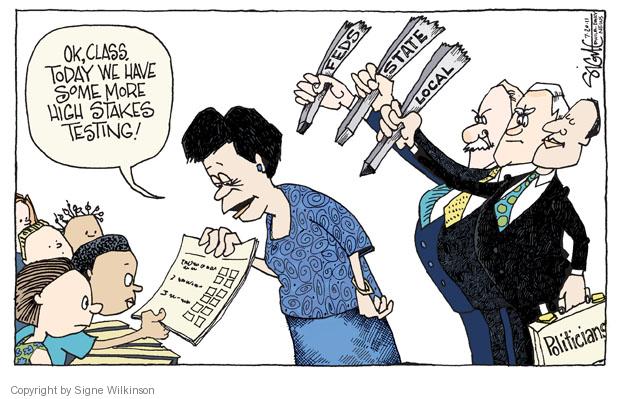
High Stakes Testing


Retrieved from: Seattle Education


In Ontario and in many other provinces, there are high stakes tests that students must take. According to  "The Glossary of Education Reform" defines high stakes tests as "..tests used to make important decisions about students, educators, schools, or districts, most commonly for the purpose of accountability—i.e., the attempt by federal, state, or local government agencies and school administrators to ensure that students are enrolled in effective schools." That said, high stakes tests can be very stressful to everyone involved - i.e. teachers, students, parents, etc. In Ontario, there are Education Quality and Accountability Office (EQAO) tests that students take in grade 3, 6, 9 and 10. In grade 10, students must pass the Ontario Secondary School Literacy Test (OSSLT) to earn an Ontario Secondary Diploma. 

During my last placement, I had the opportunity to witness students prepare and write the OSSLT. It was a very stressful time for both students and staff members. Throughout the whole duration of my placement (5 weeks) students were told over and over again how important this test was; I felt very sympathetic to them. That said, I believe high stakes tests are a necessary evil; some sort of test has to put into place to hold schools and students accountable.

Dissection vs. No Dissection

Retrieved from: Cartoon Stock


In the biology classroom, students are required to preform some sort of dissection to satisfy curriculum expectations.  Expectation E2.2 in the grade 11 biology curriculum states that students should "....perform a laboratory or computer-simulated dissection of a representative animal, or use a mounted anatomical model, to analyse the relationships between the respiratory, circulatory, and digestive systems". This states that students should either preform a dissection in a laboratory or a computer-stimulated dissection. Many times, teachers prefer to satisfy this expectation by scheduling a dissection in class (laboratory). There may be students that prefer to preform a computer-simulated dissection due to personal beliefs and reasons. That said, teachers should give students the choice between performing a dissection in class or a computer-simulated dissection using programs such as Gizmo. By doing this, teachers avoid the complaints of students and parents while satisfying curriculum expectations.